

With so many competing demands on a business, how do you decide which goals will have the most impact on your business? This article and accompanying workbook provides a framework to evaluate your current situation and the options available.
A goal is a desired outcome that you want to achieve within a certain timeframe. The process of setting a goal helps you to define what success means for your business and how you will measure it.
A clear goal provides a roadmap for your business, outlining the steps needed to achieve your objectives. This provides focus, enables you to create an efficient plan and to prioritise your efforts and resources.
With an effective goal, you are never wondering what next. As a business, you do not have to micromanage – you empower your team to get on with it. As a solopreneur, it’s possible to map your time out, reducing the feelings of overwhelm and procrastination.
Goals go hand in hand with a plan. In order to create an effective plan, you need to know your destination. With an endpoint decided, it is then possible to identify and evaluate the most effective methods of achieving this. Your action plan will be the activities you need to complete to reach it.
Decide on your goal – what you want to do
Identify effective strategies – how you are going to do it
Make an action plan – what you need to do to make it happen
This blog will focus on the “what” in the diagram below – how to select the optimum goal for your business. In order to evaluate each goal, having a view on the “how” you will approach it is necessary but not the detail.

Goals should be set for both short and long-term time periods.
A goal is something you can visualise. The further away it is, the harder it is to envision in detail. It becomes more of a direction or mission for the business. With a clear aim, it is easier to decide what is necessary to realise your vision.
Short-term goals tend to be more successful, the tighter timeframe means the end result is in sight and enables you to be specific about the activities and resources required to achieve it.
Short-term goals should always be set with the long-term direction in mind – do they contribute towards the ultimate goal? If not, should you be considering them at all? Are they a distraction or a nice to have?
It is often easier to view a long-term goal as a series of short-term goals, some worked on concurrently, others started as another project closes. This has the benefit of reducing overwhelm whilst ensuring progress is made. As each short-term goal is completed, it is a time for review of progress and an opportunity to adjust if necessary.
Many businesses have a long-term goal which sets their direction but focus delivery on a series of short-term goals set for annual, quarterly or monthly targets. The quarterly or 90-day planning period is popular because it gives enough time for a significant project to be delivered.
The simple process below works whether you are setting a long-term or short-term goal:

Any goals you undertake should be relevant to your current business situation. First, assess the status of your business to measure progress and identify opportunities to grow. Reviewing the performance of previous goals and projects prevents repeating previous mistakes and builds on your successes.
There are usually multiple ways to achieve the same objective. The obvious preference is often based on previous experience and the available expertise and resources. The goal setting period is an opportunity to be open to generate new ideas and challenge existing practices. As your business or market evolves over time, it is necessary to adapt your plans to respond effectively.
Filter and evaluate your ideas in the context of your business strengths and direction. Understand the criteria that will help you to make the most effective decisions. Which goals will contribute to your long-term direction and help you reach it fastest? Are you in a position to action them now?
Click to request the setting goals workbook now
Deciding which goal to pursue can be tricky for solo business owners or teams when there are multiple options to consider. Even if you have one clear goal, the first step should be to step back and review the last year or goal-setting period.
Which goals were set?
What were the results?
What secondary activities were successfully delivered as part of reaching these goals? For example, a project to improve email automation sequences may have been completed as part of a goal to improve customer acquisition or retention.
If any projects have not been successful or delivered, what is the impact on how the business has performed? Have you implemented workarounds or dedicated additional resources? Is this goal more or less of a priority now?
Review your numbers for your financial performance, orders, customer acquisition, retention, traffic and social media. What was the impact on your business and are these results in line with your predictions?
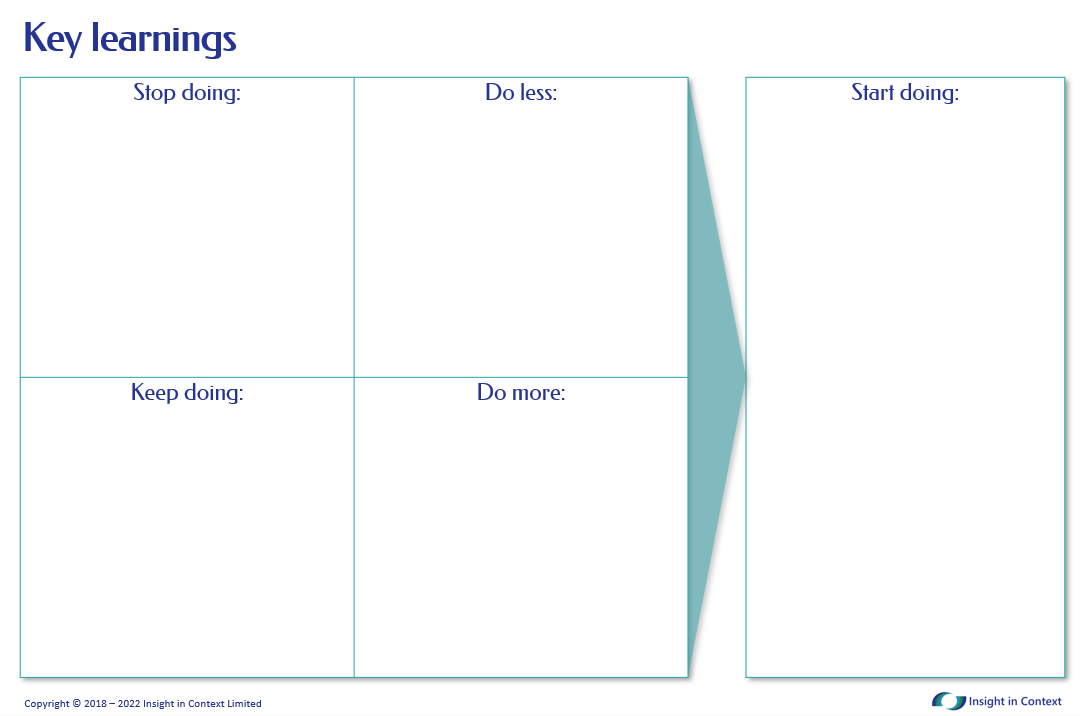
You don’t want to be repeating the same mistakes as last year but you also want to keep what worked and build on it. The grid below is a useful way to summarise the key learnings.
Customer requirements and market dynamics will naturally change over time, leading your competitors to respond with marketing and product development initiatives. Doing this analysis regularly helps to keep you abreast of movements and is an opportunity to challenge your strategic direction.
Use the competitor and market research to create a SWOT for your business. A SWOT analysis – looking at Strengths, Weaknesses, Opportunities and Threats – is a commonly used technique to identify and communicate where a business benefits from a competitive advantage. Strengths and weaknesses are the internal characteristics that a business has an influence over, such as product range, systems and channel partners. Opportunities and threats are external to the company – changes in technology, the market or society.
Covid required many businesses to change their practices rapidly. Some were better placed to do that and quickly adapted their customer engagement and delivery processes. Covid has had a lasting impact with more people working from home full or part-time and reliance on online deliveries.
What areas of your business do you consider strengths? Do you need to work on any in order to take advantage of new opportunities or potential threats?
Click to request the setting goals workbook now
When challenged with setting a goal, people often hit a wall. They can go blank or have so many ideas, they become confused and indecisive.
What is it that will make a difference? How do you know this will be the right thing to do?
Do you go big or play safe?
Do you keep the focus on the long-term goal or investigate a new opportunity? Are there issues you need to address that are preventing you from being effective now?
If you already have a long-term goal (and it is recommended that you do) what are the most effective options to move you closer to this goal? If your long-term goal covers a 3 to 5-year horizon, your focus should be tighter on what will make a difference. If the long-term goal is over 10 years, you potentially could be more creative with your options.
Ideas are often generated during the context stage where you review business performance, reflect on key learnings, undertake market analysis and generate a SWOT. The process identifies areas which are naturally a good fit with your expertise and resources so you can leverage these strengths further or areas which impact on the success of your business. The market and competitor analysis will identify new customer or product development opportunities to consider.
An alternative approach is to determine a financial or sales target and then calculate what you need to put in place to get there. Set 3 targets – a secure level which you are reasonably confident you will reach (or need to reach to continue to operate), a planned target which you work to and a stretch or dream target.
Even if the planned target is based on previous experience, as a plan is put into practice, situations evolve and you will need to adapt. For instance, a supplier could go out of business, a competitor target some of your key customers or you could benefit from a new opportunity such as a joint venture.
Having a big goal to aim for is exciting, it stretches you but it could also be overwhelming. Whilst it is important to be realistic with your timeframe, resources and expertise, are you playing it too safe? Ambitious goals may be perfect to set as a long-term goal. Think about what you need to get in place to achieve it and set these as milestones for short-term goals. Even if you don’t reach your ultimate goal, you will have significantly moved forward.
Every business should have a long-term goal. Without using this as the strategic direction, they are prone to bounce around, picking opportunities as they become apparent or are easy to act on. With the long-term direction known, businesses can assess whether these new opportunities are distractions or will move them towards their ultimate goal.
Alternatively, if the big goal is too much of an unknown at the moment, set a goal which is a steppingstone, testing your ability to access a market or develop the expertise required. You can then assess the success of this interim goal and decide whether to continue to build on it or change direction.
Breaking down long-term goals helps maintain momentum as you focus on reaching each stage and acknowledge your progress. The approach of setting a big goal is top-down – you set the main goal and break it down into smaller distinct goals. Steppingstones is a bottom-up tactic – where you build up towards a bigger goal and assess success at each stage.
You are likely to generate more ideas than you can possibly implement. Consider which options build on your current progress and take you towards your long-term goal.
Once you have got them all down, identify similar ideas and group together using a method which helps you most. For example, you could categorise them into the following operational areas:
product research marketing systems
Or categorise them by impact on the business or a logical timeframe – eg. one project needs to be completed prior to another one.
Aim to create logical connections, see a path to build on each project and remove redundancy. At this point, you should be able to identify several strong possible goals or even the one that is an obvious choice.
Click to request the setting goals workbook now
You don’t need to do everything at once.
The aim isn’t to complete as many goals or projects in the shortest time possible. It’s to choose the most effective way to navigate to your long-term goal. Going at breakneck speed isn’t ideal either, it sets you up for overwhelm and potential failure when elements do not come together quickly enough. Steady progress allows you to assess developments with more clarity and adapt when necessary.
Knowing why this goal is important to your business – whether it is from an inner drive or made via pragmatic analysis – is key to setting the right goal.
Develop a set of criteria that you can assess your projects and goals against. You will always have competing or emerging opportunities attempting to divert your attention – this criteria acts as the reminder of the logic you applied. Refer to it when you are considering changing your direction.
To be able to assess each goal against this criteria, you will need to consider how you intend to approach each one.
You should have a clear expectation of the result or benefit to be gained from the goal. It should be measurable and achievable within the timeframe available. Once you get specific about results and how you will measure it, your goal becomes an objective rather than a vague aim.
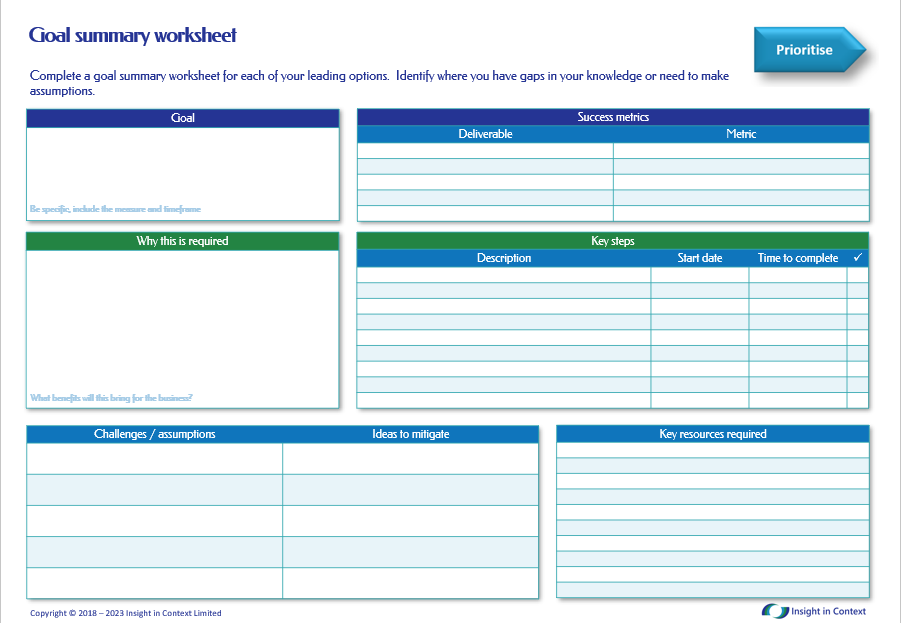
The planning is at a high-level and it’s expected that not all information may be available to you at this point. Make a note of the assumptions or challenges you may face and how you would mitigate them – ie with more research or expert input.
The workbook includes a goal summary worksheet. Complete one for each of the objectives you are considering.
Understand the level of risk you are taking. Is your goal relatively straightforward? If it is complex, do you need to plan in more detail to understand how or if it can be completed? What would happen if you start and address solutions along the way? In many projects, the exact scope of a deliverable depends on another task being completed first. Do you have the expertise, resources and motivation to make it happen and make decisions when needed?
Consider whether you are in a position to complete this goal now? What are the key steps you need to complete? Do you have the expertise or resources available? If not, what would it take to make these available to you?
If you are not in a position to proceed, consider if this objective is the highest priority for you. If not, chose an alternative that you can work on now.
If you have multiple competing objectives, create a roadmap where you schedule in goals outside of the immediate timeframe being considered. This will enable your planning to become more continuous and naturally grow to the next phase. Any short-term goal should contribute towards your long-term objectives.
There will always be multiple ways to achieve the same goal. There will always be competitors who provide similar solutions and new technologies that will distract you. If you know your direction and why you have committed to it, you are in a better position to avoid these distractions and focus on what will be the most effective solution for your business.
Be focused on what is really necessary to get to completion. There will always more you can do so take care not to over-engineer solutions. Simple is often best. Know what your customers value and how you can most effectively provide it.
Do you have a standout, obvious goal? Do you know the approach you will take and have the resources to act on it now? If you have several viable options, apply logic, using a decision criteria matrix.
Use the goal summaries for each of your goals to answer the decision criteria matrix in the workbook. Add criteria which is specific to your business situation – such as execution speed or revenue goal.
Which goal scores the highest?
Now you have reached this conclusion, how does it feel? Are you happy that you can fully commit to this? If not, identify your what the misgivings are. Are they valid? Can you address them quickly with research or finding solutions?
Sometimes, once you start, the answers become obvious. It is the unknown that is making you hesitate. An antidote to that is working on your plan and removing some of the obstacles with solutions.
Your goal typically says little about how you will achieve it. Objectives state the goal with a measurement and timeframe. Once the specific aim is stated, you can start working on how you will achieve it.
There are often multiple ways to achieve the same objective. You need to choose those strategies that are most appropriate for you – considering the specific expertise or limited financial resources within your business. You may have already identified the strategies you will use for the key steps on your goal summaries. If not, brainstorm and evaluate your options.
Strategies are the approach you will take, whereas tactics are the method you will deploy to deliver the strategy. Again, there are multiple options which could be considered.
Once the strategies and tactics have been decided, create an action plan. Depending on the complexity of your business, the goal and the approach taken, at least one project will need to be defined. Each project needs to detail the tasks to complete. These tasks need to have an estimate of the time they will take and the resources required to complete them.
As you get in to the detail, it may be necessary to use a project management tool or spreadsheet to keep a track of the tasks and resource commitments. By keeping an eye on progress, you will know if you have to adjust to compensate for any issues that may crop up.

You’ll also be automatically subscribed to my email newsletter. You may unsubscribe at any time. Check out our privacy policy here.

It’s always worth setting goals, they refine your purpose and give you direction. When you find yourself being distracted or experiencing self-doubt, knowing what you want to achieve and why will help you keep on track and focus your resources and energy to accomplish your objectives.
So what make a good goal?

The process of setting a goal is relatively simple but putting it in to practice is usually more complex when there are a myriad of choices to be considered.
This article contains hints to help you challenge and refine your decisions to improve outcomes and smooth the path to completion.

We can always improve our productivity and it can be easier than you think. This article covers strategies to help you be more productive on a day-to-day level.
From having a clear idea of your goal to planning how to deliver it, there are multiple ways to improve the process.

You’ll also be automatically subscribed to my email newsletter. You may unsubscribe at any time. Check out our privacy policy here.
