

When you are starting a business, you get the chance to shape how you work and what you provide for customers. So why not make it work for you? Do something you love doing – that you wake up to every day excited and inspired to start working on.
Your obvious priority is probably “can I make money out of this?” We all need money to live. But a sole objective of making money sounds dull to most people. Why don’t you just get a job? There would be less stress and uncertainty.
Everyone’s motivations will differ but without a passion or interest in the impact your business can generate, it will be hard to build and sustain momentum.
The sweet spot model is useful to reflect on how your ideas fit with your current situation, aspirations and expertise. At a top-level, you are asking yourself:
If the answer is “yes” to all three, then you have an idea that fits in your sweet spot.
Ideally your preferred solution would fit at the centre of this diagram – the sweet spot – the intersection of what you enjoy doing backed up by your expertise and an identified market opportunity.
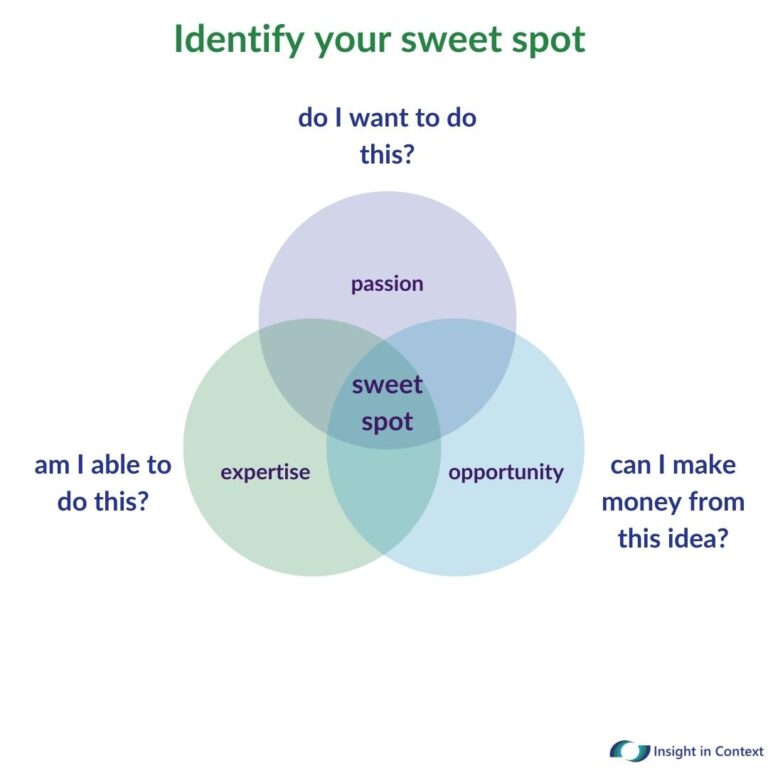
In practice, each of your ideas will be influenced by one of these categories more substantially than the other two:
This article discusses how to use the sweet spot model to generate ideas and identify the strongest. Use the workbook to create an audit of your expertise, passion and relevant market opportunities. Can you see where some of your ideas would fit between these three elements?
Do you have any that sit within the sweet spot? Which might require a compromise and why?
Sign up to access the sweet spot workbook
What are you passionate about? Are you driven by helping people, creating products or resolving issues? If passion feels like too strong a word, what could you happily do all day?
For example, is it helping clients to utilise the power of social media to connect with their customers, finding solutions to environmental problems, or creating furniture or jewellery?
Focusing your business on something that you enjoy doing won’t necessarily result in zero stressful days but the end result will feel more satisfying for you. Understand the core values of your business so you can develop a clear strategic direction.
Being able to list your areas of expertise may be the easiest part of this exercise. Also include supporting functions such as your ability to systemise or quickly analyse issues. Often what comes easy to us, is not seen as a strength whereas others can struggle and waste time on the same task.
Copywriting is a good example of this. It may simply be a tool used to achieve an end result such as a blog post but it is key to producing effective communications in an efficient manner and, most importantly, inspiring the reader to take the desired action.
Being able to recognise your strengths and leverage your expertise effectively will enable you to work more efficiently and, in turn, generate more revenue. This is not just through taking advantage of time savings and producing reliable results but by exploiting your knowledge or expertise and being viewed as an authority or the market leader in your field.
Do any of these also appear in the list you created in passion? You can’t be everything to everyone, which are your key skills? Which are most in demand from your customers (or potential customers)?
An opportunity is more than an idea, it is an idea backed up by demand. As such, customers should be ready and willing to pay for the solution to their problem.
How much knowledge do you already have of your intended market and customer needs? Can you articulate the pain or gain potential customers want to move away from – their motivation for seeking a solution?
How do you know there will be a demand for your solution compared to existing competitors offers? How will you package and communicate your offer to be more appealing to your target audience?
At this idea stage, don’t be put off by all the unknowns or reasons it may not work. Acknowledge and document them. Then do further research to find solutions or market information.
Download the worksheet to map where your ideas sit in the sweet spot model.
Sign up to access the sweet spot workbook
What if you can’t find an idea which fits neatly in the intersections of the three circles? It doesn’t mean that you have to keep searching for the perfect one or give up. A weakness in one intersection can identify areas where you will need to find solutions or compromise.
You may be choosing to follow your passion, knowing that there is demand for a specific service you are really interested in.
Although you may lack the core expertise to deliver your solution, you have identified which skills you need to develop or outsource. This then becomes a trade-off between time vs money. Time to learn the skills vs financial resources to outsource or hire in the expertise.
This intersection can be viewed as your “mission”, where you can deliver significant transformations and benefits. However, you may also feel under pressure responding to the demand which can take away some of the joy.
The intersection between opportunity and expertise benefits from being able to leverage and improve on processes to generate a greater financial reward. You may have the advantage of credibility but on the downside, become bored as it is not something that particularly inspires you.
However, if you don’t feel a strong drive to create your business, it can become just another job.
Can you identify areas that you do enjoy? Can you expand those parts of the business? Or work with other businesses who are weaker in these areas to exploit your expertise?
In your business, it may feel like there is an alignment when you have a strong presence in expertise and passion. The business may feel comfortable but the lower financial reward may cause the business to struggle or even be unsustainable in the long run.
What can you do to develop the opportunity, for example develop high-ticket services or identify a similar idea which will be more financially rewarding whilst still satisfying your passion and utilising your skills?
Sign up to access the sweet spot workbook
Even if you have ideas that you want to pursue that satisfies your sweet spot model, you may make a strategic choice to start with a solution that only satisfies two:
Opportunity and expertise – know you can move quickly to provide solutions that your market wants. You establish your business and customer base, then move to provide your ideal solution which fits your passion and sits within the sweet spot.
Passion and opportunity – the immediate demand dictates the solutions you provide and the means to deliver them. As your business becomes more established, you develop the skills and efficient processes and bring expertise inhouse.
Expertise and passion – you feel driven to develop this solution and can see the potential but perhaps you are early to market with a new technology or format and your ideal customers aren’t ready yet. In the longer term, the solution may be to develop new features, stronger branding or channels to market. Alternatively, customers may become more familiar with the concept and appreciate the benefits it provides so your revenue increases at a faster rate.
The visual nature of the sweet spot exercise helps you to quickly evaluate at a top-level if your ideas will harness your expertise with what you enjoy doing to exploit a known market opportunity.
By leveraging your existing knowledge and interests you can create the type of business that you want and that works for you in the short and long term.
Even if you can’t find that one perfect idea that sits in the sweet spot, do not be disheartened. Start where you are with your best option at this point in time.
Your business will evolve as you build and find your place in the market. Make pragmatic decisions, start small, keep testing and develop your offer and business towards that elusive sweet spot.
As you get up and running, be prepared to adapt to new challenges and opportunities. Be open to continually improving and learning new skills. No one knows how to do everything in a business. That’s all part of the enjoyment and satisfaction of shaping your future. Having to adapt your plans is not always a problem but can be viewed as an opportunity to grow in a different direction.
Don’t forget to download the worksheet here:
Sign up to access the sweet spot workbook

You’ll also be automatically subscribed to my email newsletter. You may unsubscribe at any time. Check out our privacy policy here.
No two businesses are the same. The great thing is you get to shape your business the way you want to. There are no set rules for what will work and what won’t.
Set yourself up for success prior to investing your time by challenging yourself to answer these questions.

As a small business owner, finances are usually tight. However, the Internet can be a great leveller, enabling micro competitors to grow their audience and launch a product with little to no expenditure. To be effective, you will require a clear strategy focusing efforts and leveraging your existing network and resources.

Are you at the start of your business venture and still considering your options but phrases starting with “if only…” or “I can’t because…” are repeatedly entering your thoughts?
Check out these tips to help you overcome your negative talk and start to take action.

You’ll also be automatically subscribed to my email newsletter. You may unsubscribe at any time. Check out our privacy policy here.
